Why do People Self-harm?


Struggling to understand this behaviour, especially when you are supporting someone close to you struggling with this behaviour, can be very difficult. Self-harming is such an important topic and is in need of more awareness in the mental health realm, which is why I was inspired to write about this.


Self-harming is a way to regain emotional balance to extremely disturbing emotional disturbances. These behaviours could be symbolic to taking an aspirin for recurring headaches—there is immediate relief, but the pain is guaranteed to resurface.

Self-harming include not only self-injuring but also behaviours such as food restriction, binging and purging, or binge drinking and drug addictions. These behaviours could stem from mental health concerns such as trauma and coping with depression, anxiety, grief and loss, and pressure from life transitions.


The two most common reasons for self-harming are:

1. to control the extremely painful and frightening experience of overwhelming emotions


2. to escape from the awful feeling of being numb and empty.⁣

How you can help if you know someone who is struggling with self-harming:⁣


• Don’t be afraid to ask what they are going through or if they have anyone they trust who they can talk to about what is happening.⁣ Follow your instincts: if you suspect signs of depression or suicidal thoughts/ideation, ask them. The conversation might be missed if no one talks about it.

• When the conversation starts, empathy and validation are crucial: communicating that you understand and value the other person’s experience (especially emotional experience), even when you may not necessarily share the same opinion.⁣ Showing up is more helpful than you think.

• Typical reassurance techniques may not work: such as “time will pass” or “can’t you choose to be happy?” may be seen as inconsiderable and could do more harm than good.⁣


• Help them find resources. Find a mental health professional who can help them gain coping strategies to manage self-harm and for them to have a secure, confidential space to talk about what they are experiencing. Your job is not there to fix/solve it.


Mental health professionals go through years of training to create a secure environment for those hurting to express what’s happening and they provide unconditional positive regard. If the professional specializes in the self-harm behaviour you are struggling with, please reach out. Your story is important. You do not have to struggle with this overwhelm alone.

If you or someone you know needs help, here are some Crisis Resources if community isn’t available:

(we try to include ones that don’t involve police intervention)

604 Defund Network linktree

List of Alternatives to Police Wellness Checks in ‘Vancouver’

• Explaining the Care not Cops Model 

• Indigenous Crisis Response Team: 604-219-9384; icrt@vch.ca; Mon-Fri 8:30am-4:30pm (for holistic, culturally safe, crisis response for people in the DTES; bypass police intervention!)


• Mental Health Support Line: 310-6789 (no area code; connects to local BC crisis line without the wait; may involve cops)


Disclaimer: Everything posted here is for educational purposes only and is not a replacement for individualized medical or mental health treatment. If you are in need a therapist, book a free consultation with me via this
link.

 
A Therapist’s Prescription: Overcoming Creative Blocks


It’s 2020: the start of a brand new decade! 3 intentions I am setting for this year is to pick up and learn how to make digital art, experience what yoga has to offer, and write or create even during artist blocks.

Adjustments.jpeg


Reconnecting with the creative light inside of me has been my saving grace.

Back when I was a senior in high school and throughout my undergraduate program, I endured more than half a decade without making art. I focused all my energy on schoolwork: typing out endless lecture slides, reviewing and taking in coursework, and feeling really out of touch with my inner artist. Maybe you are going through a creative block and not feeling any motivation at this moment. If you are interested in integrating coping strategies for overcoming a creative block, keep on reading.

I work with individuals and help them cope with overwhelming emotions in creative ways. Art therapy can be a powerful experience for anyone who is going through a creative block. Art therapy is also a great approach for anyone who is looking to reduce stress, build intention, struggling with fear of failure or perfectionism, and want to gain personal insight.

From many experiences of going in and out of creative blocks, I am here to share with you…

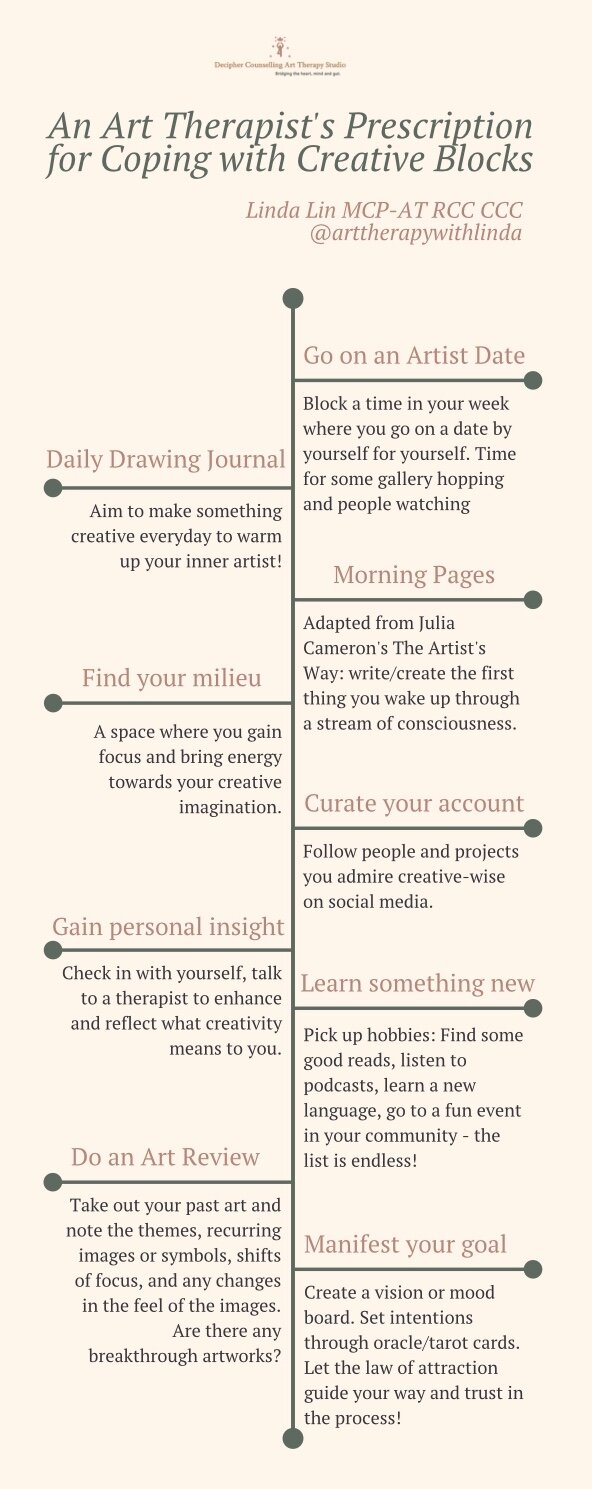
A therapist’s guide for liberating creative blocks

Go on an artist date: Block a time in your busy week where you go on a date by yourself for yourself. Resting and having fun is healthier and more efficient than self-sabotaging! Time for some gallery hopping and people watching.

Start doing daily drawings and form it into a Daily Drawing Journal (DDJ): I am creating daily art prompts in the beginning of every month for 2020. Download January’s art prompt list here!

Morning pages: Adapted from Julia Cameron’s Artist Way—3 pages of longhand stream of consciousness writing done first thing in the morning. Learn to not alter your neurotic thoughts or emotions. It is difficult at first, but you may find yourself forming ideas for your next creative project!

Find your milieu: A space where you can gain focus and energy towards your creative imagination. I tend to get inspiration from specific cafes and studios I work at. If you are working from your office or room, try setting up your space to be a reflection of what you find healing. Even if you are working in a cubicle or on a laptop, find an image/s that inspires you to bring back creativity and stay grounded (set it as your desktop background or frame it).

Curate your account: If you spend a lot of time behind a screen follow people who you admire creative-wise and their accounts. I have been curating a collection of therapists on my instagram account and have been listen to some of their podcasts and visiting the wonderful resources they put out on their websites. Find some apps or widgets to remind you to check in with yourself, do a quick body scan or with how you are feeling in the moment. Sometimes when we neglect our Self, it can lead to burnout and increase the potential for creative blocks. Pinterest a vision or mood board to create manifestations.

Gain personal insight and take in knowledge in this healing journey: Get closer to your struggles. Be your own supporter and cheerleader! Find a good reads to enhance or redefine what creativity means to you: I highly recommend the books Big Magic, The Artisan Soul, and The Artist’s Way by Julia Cameron. Many Art Therapy books are great for creatives who struggle with perfectionism or self-esteem when it comes to expressing your inner artist. Find therapist or talk to a good friend about your experiences and gain more clarity on how to support yourself.

Learn something new: Pick up hobbies such as reading good books, listen to podcasts, learn a new language, go to a fun event in your community—the options are endless! This is something I am working on all the time to keep me going :)

Reflect by doing an Art Review: Take out your old artworks—it’s time for a revisit. Rearrange the art based on themes or in chronological order. Note down any patterns you see, recurring images or symbols, shifts of focus and any changes in the feel of the images. Are there any breakthrough artworks that you created? Invite a friend over for a second look and see what they notice!


No matter where you are in this creative block, you are exactly where you need to be! Turn toward your suffering whenever you can. Acknowledge the struggle, name the problem to externalize it. You’ve got this!

Disclaimer: Everything posted here is for educational purposes only and is not a replacement for individualized medical or mental health treatment. If you are in need a therapist, book a free consultation with me via this link.

 
Free Download: 8 Intuitive Art Prompts


Download 8 Free Intuitive Art Prompts for Body Image and Food Concerns below

Disclaimer: Everything posted here is for educational purposes only and is not a replacement for individualized medical or mental health treatment. If you are in need a therapist, book a free consultation with me via this link.
 
EMDR: what it is and from a therapist’s experience
 

“The past affects the present even without our being aware of it.”― Francine Shapiro

the-false-mirror-1928.jpg

Two weeks ago, I attended and completed a 5-day intensive EMDR (Eye Movement Desensitization Reprocessing) training course. I went in being a skeptic learner. I came out from that training truly feeling the power of EMDR and I am never going back. 

The World Health Organization lists EMDR as one of the most effective treatments for trauma and is part of the clinical protocol in caring for Post Traumatic Stress Disorder. EMDR is both an evolving theory about how information is perceived, stored and retrieved in the human brain and a specific treatment method based on this theory (Shapiro, 1995, 2001).

EMDR allows the individual the room to process through ‘unprocessed’ memories and recreate meaning of the memories. EMDR therapy can be helpful in introducing newer and more adaptive neural pathways for what is happening currently and future anxieties as the negative associations are no longer present.


The Neurobiology of Memory

To understand how EMDR therapy works, we need to understand that memories are stored in the brain through neural networks. A neural network is a group of interconnected brain cells—neurons—that fire together. When traumatic memories are stored, they are part of maladaptive neural networks that limits the ability to adapt, process and resolve stress associated with the trauma.

REM Sleep

The eye movements used in EMDR therapy seem to stimulate the same processes that exist in rapid eye movement, or REM sleep. During REM, we are in deep sleep and we may dream. There is also stimulation in learning in the brain. The eye movements in EMDR represents bilateral stimulation that activates both left and right hemispheres of the brain. 

Also similar to REM sleep, eye movements from EMDR therapy help transfer memory, including the emotions, physical sensations and beliefs associated with the original memory, into semantic memory networks (long term memory). 


Who can benefit from EMDR?

A lot of people associate EMDR therapy with trauma, as it’s seen to be effective to treat individuals who struggle with trauma or Post Traumatic Stress Disorder. However, EMDR therapy can be integrated into many different populations and mental health concerns such as for self-use, relationships, military, dissociation, children, addictions, grief, phobias and pain.

Which memory of mine can be processed?

EMDR is effective regardless of when the event took place: it could be an incident from 15 minutes ago, 15 years ago. EMDR invites the client to have total free association across their life span: past, present and future. 

EMDR could process the future?

An anxiety refers to our anticipation of a future concern. Anxieties are present feelings of stress that are based on our past learned experiences to prevent and react to any similar situations in our future. Therefore it is possible for some of your anxieties to be linked with the same neural network. 

Self-practice: See if you can group your anxieties together based on past learnings with a core belief. Here is a list of some core beliefs to help you get started.

Is EMDR therapy triggering? What if I don’t want to bring up the past?


There are varying versions of processing through bilateral stimulation (eg. unrestricted, contained, or restricted processing) that the trained EMDR practitioner assesses in which to work with their client based on their best clinical judgement.

What if my eyes are strained or if I get headaches from the eye movements?


Through decades of research on this modality, EMDR therapy is now more adaptive than ever. You don’t have to do eye movements for it to work. Therapists are able to do tapping (eg. alternating from hand to hand), auditory (eg. tones played from one ear to the other), tactile bilateral stimulation depending on what works for the client.

My experience with EMDR

I found that the vividness and the disturbance of the incidents I wanted to process became so much more manageable. The memories I processed didn’t ‘disappear’ after the therapy treatment and I acknowledge and recognize all the emotions from the past experiences. 

However, I was able to let go of the feelings of resentment and disgust* because these were the emotions that kept me from moving past the memory. These were the feelings I latched onto that created the neural connection to keep thinking and reliving it. 

As a therapist, EMDR training gave me glimpses of hope and wonder towards helping out those unable to get past their past. 

*these feelings are subjective to whatever experience/neural network you are processing

Paired with Art Therapy

I found that EMDR resourcing techniques, to access and activate memories, can be worked with Art Therapy especially when it comes to various visualization exercises such as the container and inner peaceful place. 

“Unlike other forms of psychological disorders, the core issue in trauma is reality.”

—Bessel van der Kolk, The Body Keeps the Score