Posts in Create
Time as a Meadow: Reframing How We Relate to Time


quick note: this blog post is not written by AI. The writing below features ideas and wisdom of artists, personal journalling and newsletter writing, curated to what a therapist feels the world is needing these days. 
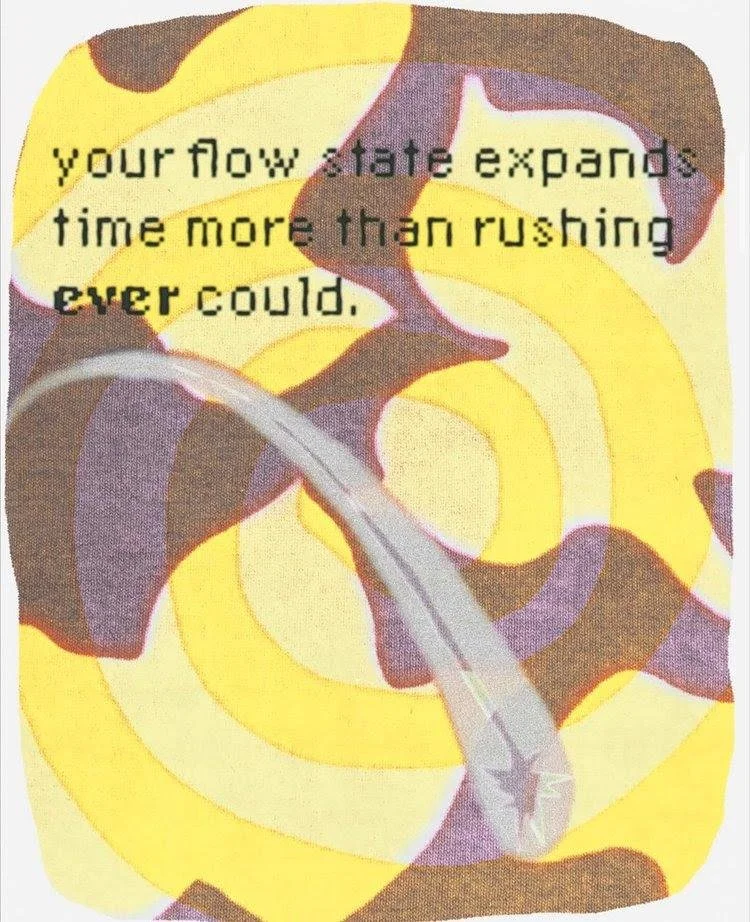
wrods that say your flow state expands time more than rushing ever could by realization by pea. Background is of an abstract yellow and purple swirl art.

Image via @realizationbypea

from our newsletter, written by Linda Lin, RCC, RCAT

Be real with me… what is your relationship with time like?  ୧ ‧ ˚ 

When I am overwhelmed, time feels like the scariest, most unattainable currency that I cannot get back once it pasts by. From the hours, minutes to seconds, I find myself reacting to my thoughts, the ‘standards’ and shoulds on how I need to be spending my time and transforming it into something valuable, productive, ~rich~.

This obsession leaks into how I see money, work, relationships and I'd hate to admit this, my entire sense of self.

I’ve met so many people who try to force outcomes to ‘shape their reality.’ That might look like getting a perfect job with no career gaps or trying to appear as though they have their life together by a certain age (we're not even on linkedin btw •̀ ᴖ •́). Over time, those expectations can attach themselves to our identity and perceived reality.
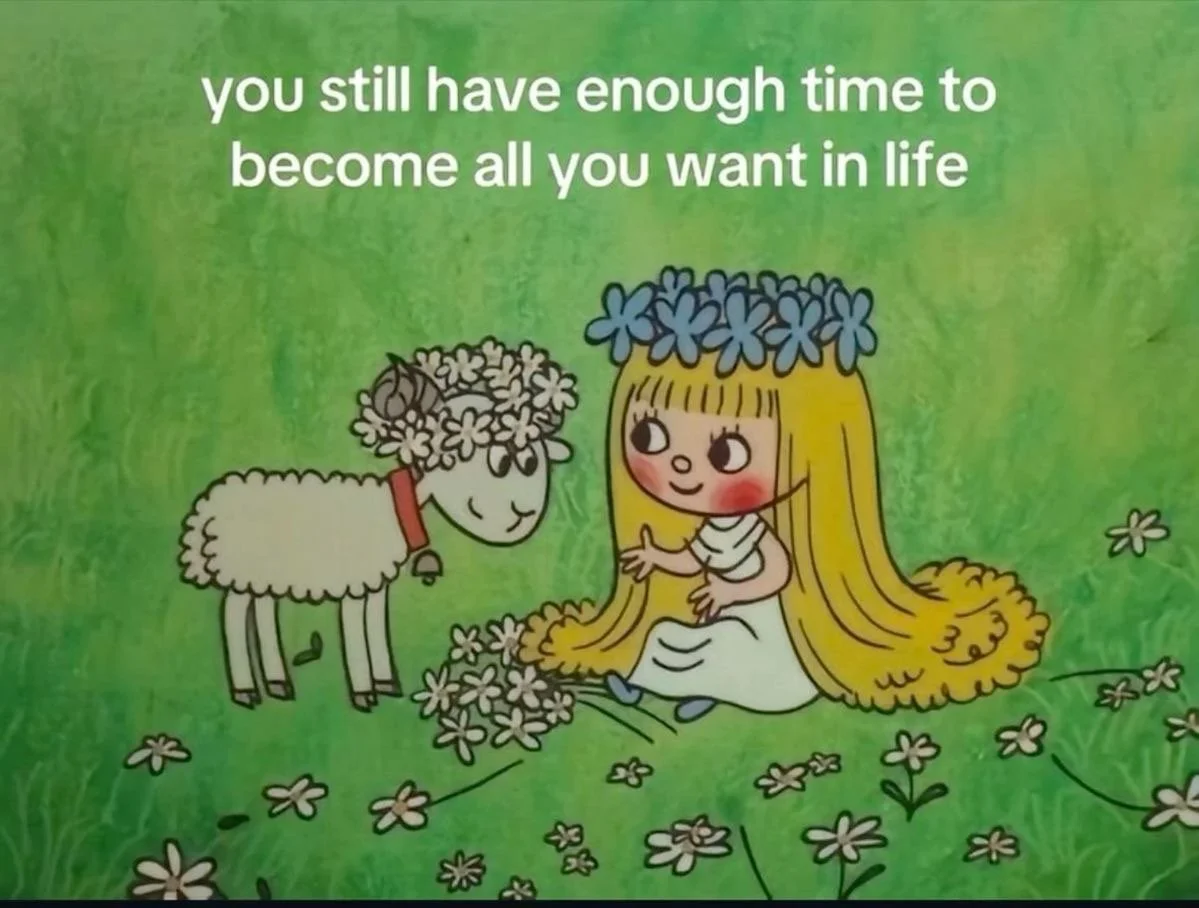
words say you still have enough time to become all you want in life with a cartoon girl wearing a headcrown of flowers and a white dress with long blonde hair smiling facing an animated grey sheep with flower headcrown on a grassy field.

via pinterest

The more we obsess over time, the more it breeds fear, frustration, hesitation and misalignment.

Did you know? 
Your energy is your most VALUABLE resource in life.

Therefore where you put your time and attention determines everything.


Instead of forcing outcomes, what if we start curating your reality with alignment, creative direction, and thoughtful refinement. Like an artist curating their work 𖦹
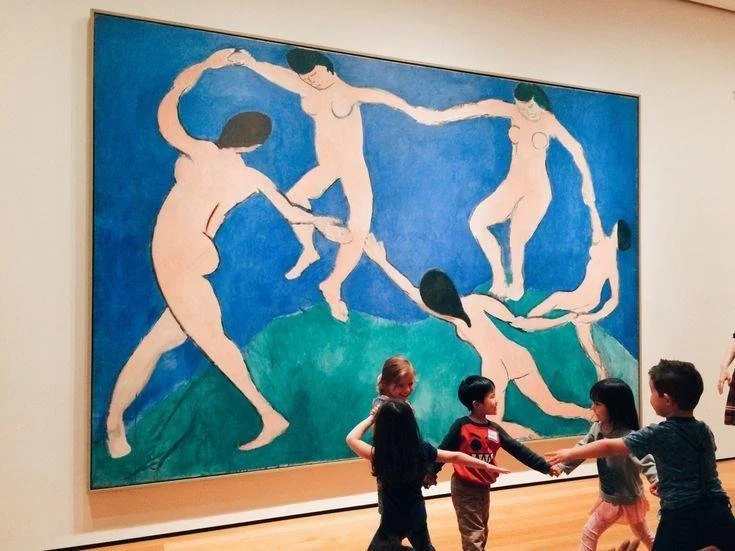
Photograph of kids holding hands in front of a giant painting playing ring around the rosie at an art museum

via pinterest

I journaled this the other day: “my relationship with time is kind, sweet, caring, full of life, light”

Perhaps mourning/stressing about time and next thing, which is heavy in weight, is dictating a relationship with time that isn’t valuable to me!

We cannot time hop in multiple streams of consciousness. 

So disappointing, am I right? It's really too bad that we can’t live in every parallel timeline like we are everything everywhere all at once. Trying to juggle all the goals, tasks, and “what ifs,” whether it’s making our days off perfect or savouring the end of summer, usually just leaves us with an abstract and confused state of feeling.

HOWEVER, I’ve been thinking a lot about quantum leaping, also called timeline jumping. The idea is that if you’re on level 1 and you want to get to level 8, it’s really about giving yourself room to believe that level 8 is just the next step, waiting for you.

Time is not something we need to centre and obsess over.

Thanks to this tiktok I watched last month, I've been on this case ever since. Obsessing about time traps us in procrastination, locks us into overwhelm, and confines us to cycles of productivity and capitalist urgency which are the very things we don’t want taking over our lives.
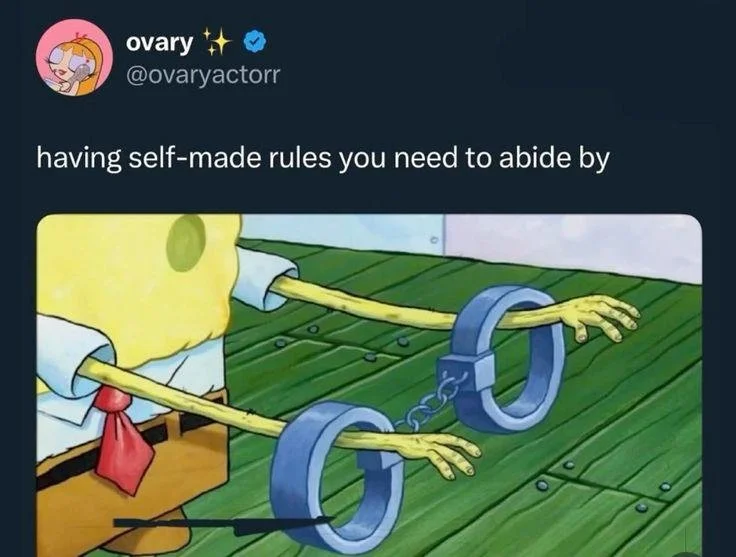
a tweet that says having self-made rules you need to abide by with an image of spongebob squarepants in cuffs links back to himself.

When our most easeful and fluid path (the realm where time flow exists) starts to blur under pressure, how can we anchor ourselves to remember how we want time and life to truly feel?

Here’s your art journalling prompt:

Draw and describe how fluid time is to you currently. Draw a portal that allows you to experience time the way you want time to feel.
 

Use your fave mediums: Mine are stickers, collaging, digital media like Pinterest images, sparkly gel pens, words, pencil crayons, oil pastels, coloured pens to express myself.

From this prompt, TIME IS A MEADOW came up for me. I call her, Mother Time. Instead of me trying to micro-manage/control time, or duelling it out with time, she is here to support me. This isn't a battle. I also don't have to mother time. Time is here for me and with me. I'm rolling with it and curious to what this art prompt will reveal for you!
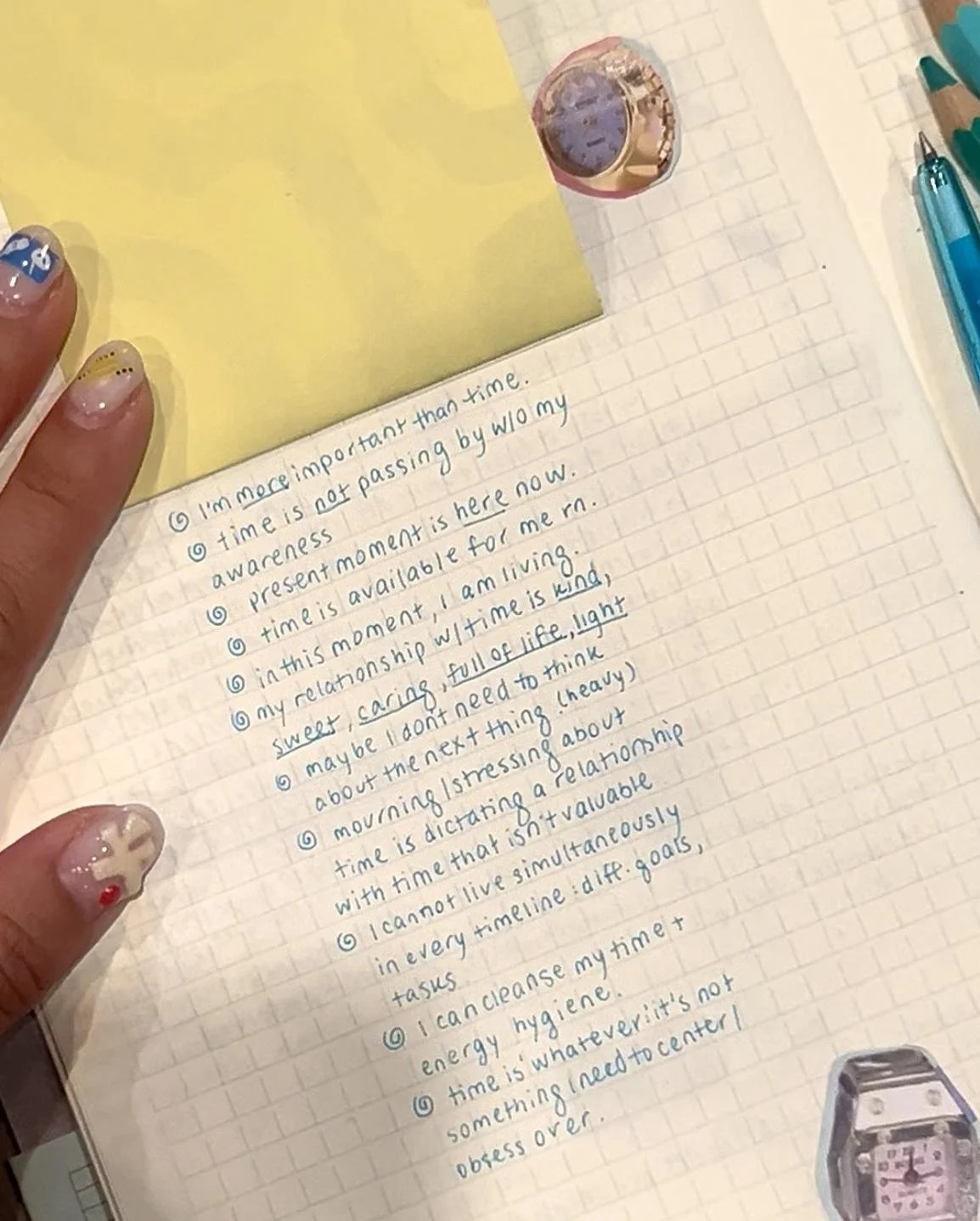
TLDR; or don't feel like journalling? Try reflecting on this in the month ahead:

✩ Gently build curiosity by learning your unique rhythm and pace.

✩ Practice your ability to redirect and focus with purpose and intention. 

✩ Slowly expand your capacity for flow instead of control with time.


I see you! ⋆˙⟡ written by yours truly, Linda


DreamLab : An Art Therapy Experience [CICA x Decipher] SOLD OUT

DreamLab : An Art Therapy Experience Rooted in Dreams and Inner Landscapes, Inspired by Marin Majić’s roundabout as part of CICA’s Art & Mindfulness series

The Art and Mindfulness Experience Series at CICA Vancouver is designed to explore the profound connection between artistic expression and mindfulness. Rooted in the belief that art is a powerful medium for healing and self-discovery, this series invites participants to engage in reflective and grounding practices through creative expression.

Art, in its many forms, offers a pathway to mindfulness by encouraging presence, introspection, and emotional release. Whether through painting, sculpture, movement, or sound, the act of creating becomes a meditative process that fosters deep awareness and healing. Our series harnesses this transformative power of art to create accessible spaces for mindfulness that center BIPOC, women, and queer communities.

Facilitated by artists and mindfulness practitioners from these communities, each experience is designed to hold space for collective healing and cultural storytelling. This platform not only nurtures personal well-being but also elevates the work of marginalized practitioners, providing them with visibility and opportunities within Vancouver’s art and wellness landscapes.

Event Details:

Save the date: Saturday, June 14, 3–5 PM

CICA Vancouver | Facilitated by our RTC and Art Therapist, Coco Huang

Only 20 spots available

Join us for DreamLab, the first workshop in CICA’s new programming series, Art and Mindfulness—a series designed to explore the profound connection between artistic expression and mindfulness. Rooted in the belief that art is a powerful medium for healing and self-discovery, these experiences invite participants to engage in reflective and grounding practices through creative expression.
Led by Coco Huang  a Registered Therapeutic Counsellor and Art Therapist at Decipher Counselling  this immersive 2-hour session includes dream journaling, grounding exercises, and sensory art-making. The experience begins with a walk-through of roundabout by Marin Majić, setting the tone for exploring subconscious landscapes and inner symbols through art.
Together, we’ll breathe, create, and co-regulate in a supportive space centered on healing, curiosity, and community. No prior art experience needed. All materials provided.

 
Nostalgia as coping


from our newsletter, written by Linda Lin, RCC, CCC, RCAT

“When did life stop feeling like this”

In the face of rapid life changes, and in the age of escapism while witnessing brutality from dying systems, the specks of our past can feel like a cushion we lean onto, seemingly simpler, easier, and happier than today.

This tweet is what prompted me to write about nostalgia as coping:

Nostalgia feels like a temporal preservation within virtual spaces. Nostalgia acts as an island we retreat to, an anchor in the face of hopelessness and restlessness. It's as if it were a freeze response to our overwhelming reality—a coping mechanism, offering us a brief respite from the uncertainty of a better future.

In times of despair and hopelessness, I tend to rely on nostalgia as a coping** mechanism. In Mandarin, there’s this phrase, 舍不得 (shě bù dé), which roughly translates to 'reluctant to part with' — that's how nostalgia feels to me. 


I find myself bonding with friends over our childhood memories, indulging in art forms like my favourite shows, listening to music by my teenage idol at the time, BoA, and scrolling endlessly on Pinterest to curate old internet energy and Y2K aesthetics into a mood board. In these digital spaces, the collective nostalgia of shared experiences emerges, eliciting a contagious, creative energy.

*Nostalgia: Nostalgia is not necessarily remembering the reality. It’s a deep longing for space and time that has passed, people we loved and/or loved us, a version of ourselves that is no longer accessible to us. 

Sometimes, nostalgic feelings bring up feelings of hopelessness and deep sadness about current-day reality. Some people refer to this experience as nostalgic depression, where the sentimental longing for the past brings up grief and disturbance.

**Coping vs. vs. processing (watch this tiktok)

Coping is like a bandaid, or first aid. It can be validating, brings awareness and tends to an emotional wound when it shows up. To cope is the attempt to stay functioning through emotional pain.

Processing is accessing our nervous system (the language of our mind and body connection)’s wisdom. It recognizes overwhelming experiences will be stored in our body. It often times feels more intuitive, trusting, understanding with context of emotional wounds.


The charm and power of art making as processing nostalgia

As we make art (a collaboration between our intuitive nervous system, the environment we are in, and earthly materials), we are choosing to engage with the full moment and a fragment of our experience being preserved beyond thoughts and feelings.

Art making breeds nostalgia, eliciting a contagious, creative energy! Art making can help with release and express emotions, storing them in the image so we don’t have to carry it all.

Here’s an art as therapy prompt for you:

(the steps act as a gentle guide and are completely optional)

1. Choose a specific time period you want to revisit from your past. Choose art materials, a playlist, a space, a comfort item (eg. a stuffed toy), or a snack to pair with this time period.

2. First marks: Invite your younger self from that time period to make the first marks. Express through your inner child you want to connect with. Draw/paint/play as if your younger self is making the marks. These may be symbols that you used to draw, or describing a feeling you remember fondly from that time.
Alternative option- embodied time: Connect with a space in time and make your first marks as if you were embodying that space in time.

3. What your younger self prefers: work with art mediums, textures, colours etc. you would have chosen when you were younger. 
Alternative option: what symbols, textures, feelings, and beings inhabit this space/world?

4. An essence of support: Collaborate with your inner child by bringing in your current self. What are some symbols or imagery you engage with nowadays that you would like to add onto this artwork to bring in an essence of support and witnessing?
Alternative option: What does your space in time/world need as resource and support? Add images for this space to feel safe and comfy.

5. Gentle check-ins with yourself - with both your inner child (or the space in time), and your current self: stretch, notice your capacity to engage/disengage, go for a walk or recharge in another room whenever you need it.

You DO NOT have to finish/complete this artwork or prompt in one go. Heck, you don’t have to complete anything if it doesn’t sit right with you.

6. Honour your art piece and think of containment and storage. Does the image need borders? Maybe you can attach your artwork in a journal. Or put a frame around it, if the image wants to be seen by others and yourself often. Where does your art piece want to be?

7. Bring in community. Work with a peer you trust, someone you want to share this with or an art therapist to support your emotional health with this exercise. 


Hopefully this art as therapy exercise prompts you to engage in nostalgia as a coping practice. To bring in a time in space or reconnect and honour your younger self’s art expressions with the creativity from your current self.

Give this art as therapy prompt a try or gift this blog post to a friend who may enjoy it! :)


The truth about intellectualizing
 

from our newsletter, written by Linda Lin, RCC, CCC, RCAT

We have been socialized with the rise of therapy speech in the past few years to logic, reason and theorize our way through what may be going on. 


Unfortunately, therapy speech and intellectualizing goes against the grain when it comes to healing experiences of overwhelm. Those unprocessed feelings from tough times tend to hang around, recycling on repeat, while our bodies bear the brunt of it all. 


If you've been finding yourself grappling with self-doubt, feeling unclear and confused - you're not alone.

Have you been feeling discombobulated? Like you’re in a deep fog, doubting your every move?


To be fair, it’s not only you who feels this. The world has been hijacked with therapy speech all over social media. People have been intellectualizing their way to numb out difficult emotions in hopes of finding clarity.

But what if I told you that intellectualizing is what’s making you doubtful?

Therapy speech hijacks our emotions. Therapy speech is a defence mechanism.

Analytical insights may be helpful when we're writing papers, when we're trying to convey the narrative behind our concerns and challenging others to hear us out.

When we place logic-first, emotion-second, it makes us…

• feel discombobulated and exhausted, in an endless spiral

• minimizes and builds up fear around emotions

• feel irritated: increase in ‘prickliness’

• store stress in our body: gut issues, pelvic pain, headaches, bracing of muscles...

• focus is on fixing, not healing

• loss of self-awareness: disconnect from our instincts

• sound like “I know more than you” or contempt in relationships

• less trusting of others or willing to ask for help

Intellectualizing is a response and a coping mechanism of trauma.

Intellectualizing does not process trauma.

I put together an art-as-therapy and visualization prompt that you can choose when you want to give yourself a moment to slow down, contemplate, build unique expression and clarity by exploring with your creativity.

Here’s your Art as Therapy Prompt:  “Pieces of Your Perspectives”

Give this art as therapy prompt a try or share this prompt with a friend :)