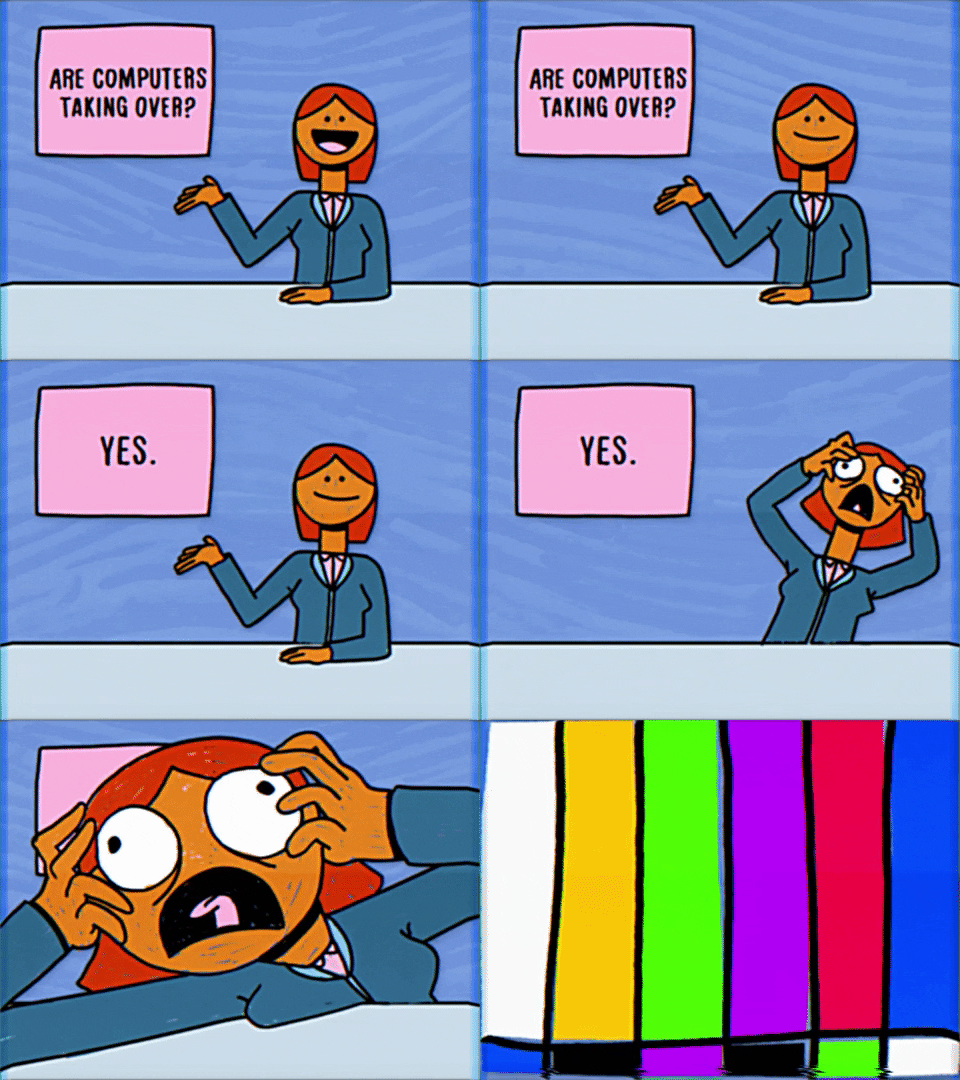
Humanity > AI


CW: This next bit is about AI. Please take care of yourself. You don't have to read this. Your wellbeing is much more important than this stuff anyways.


Is it just me or have institutions been changing their sense of speed to match that of what a machine-learning AI would be? 


The world around us have been fear mongering and warning us that "AI isn’t the future, it’s the present."


And as AI becomes more prevalent in our daily lives, it has influenced our expectations and standards for ourselves and how productive we need to be. 


Do those ‘not enough’ intrusive thoughts show up for you?

It's definitely been biting me this entire year and I'm so sick of it.


Collectively, it's being felt and it's a lot on our nervous systems, on our communities, and on the way we operate in our daily routines.

It's like adjusting to a pandemic with permanence, coming in fast at us.


This reminds me of the same intense charge race and yt supremacy has on us, and all the other -isms have on the oppressed. 

When it comes to this charge, we tend to override and not look at the impulse, or flight responses our body has tempered for us.


Our bodies KNOW what this is. 


As a therapist, my role is to support and protect our nervous systems (think of it as leaning into our experiential wisdom and presence as we move through the world). And embracing our humanity.


We need to listen to the artists and humans when working with AI. We need to center in our humanity and protect our communities. 

We need to remember what is indispensable about you.

That is what will save us.


If you are in need of a few moments, please stay here and tune into your body. Your breath. The speed of you reading and taking this in. Slow down. Literally go take a break if you feel compelled to.


Play around with your tone of voice as you repeat these words with every inhale. If you're more of a visual person, try imagining an image of each of these mantras… here it goes…


I am not a machine. 
PAUSE.

My humanity is vital for life on Earth.

PAUSE.

I am not replaceable. 

PAUSE.

I am indispensable. 

PAUSE.

I am enough just as I am.

PAUSE.

I have ancestral wisdom.

PAUSE.

I am part of creation itself.

PAUSE. And exhale……… 


How is your body doing? 

Can you orient to something supportive around you? 

Let's go with that…


Why Art is an Act of Resistance

“Resistance and change often begin in art, and very often in our art; the art of words…the name of our beautiful reward is not profit, it is freedom.”

— Ursula Le Guin 


“This is not how a human face looks” “The proportion is not right”

At first, resistance towards making art sounds like the inner critic.

That “my drawing is not up to par so I am not an artist”. 


I’ve been noticing that these critiques are ideas that originated from colonialism of what art is and isn’t.

Colonization of art has changed the way we see art culturally, politically and socially. 


Under censorship and control (aka. capitalism), our creative practices has become commodified - where art should be made for profit and for some form of gain.


Art is an act of resistance

How can we start to make art for ourselves as resistance from colonialism and for joy?

How can we connect with our images and art making that isn’t based from a lens towards the fine arts?

…working with art and images as a means to resist socio-political oppression.


Anti-oppressive art therapists are working to reclaim our creative practice and decolonize art making with art therapy and contesting to structural oppression from the psychotherapy field.


Shaun McNiff wrote in his book, Trust the Process: An Artist's Guide to Letting Go, that “art therapists are like refugees from the art world”. I’d like to think of us as rebels of the art world instead.


So how have you been rebelling in your creative practice?


“All of that art-for-art’s-sake stuff is BS. What are these people talking about? Are you really telling me that Shakespeare and Aeschylus weren’t writing about kings? All good art is political! There is none that isn’t. 

I’m not interested in art that is not in the world. And it’s not just the narrative, it’s not just the story; it’s the language and the structure and what’s going on behind it.”

―Toni Morrison


Some forms of art as resistance I have been working with are: 


  • Making zines: a form of self-publishing art that came from feminist, activist movements popularized from the 80s. When I first started working as an art therapist, I created a workshop called, Zine Therapy (I was obsessed with making them). Zines are easy to distribute, low budget, and the content is filtered through the creator’s POV. My current faves are by Bianca ✨


  • Cartoons and memes: sometimes opinionated, other times sensitive, maybe brightly coloured or humorous, through a critical lens through doodles/animations or storytelling with images … like my friend's work by John! ✨


  • Clay/pottery: when I play with this earthy medium, themes around politics of the body and ‘smashing’ the patriarchy come up (💁‍♀️to get those air bubbles out). I love the meditative and trance-like feeling when I’m on the wheel… the way this medium holds memory and can be both delicate and forgiving—like healing with trauma.


If you wanted to share your thoughts, feel free to email me at linda@deciphercounselling.com.

Save this practice and come back to it for another day. If you know someone who may like this, share this blog post with them!

Thanks so much for being here :-)

 
What Justice-Oriented Therapy Looks Like in Therapy Sessions
 
 
Five people of colour therapists: 3 sitting on a sofa, and 2 on the rug. They are holding books, paintbrushes, tarot cards and smiling at each other.

I have been reflecting how from the outside…

social justice-work,

work by creatives or

those who want to make change in the world,

…have become romanticized.

It's the work that drives us to go around what's been already mapped out.

It can be deeply healing and rewarding, and can also be gritty, hard work.

So, what does social justice-oriented care look like? It means that we are committed to providing care that is anti-oppressive and rooted in social justice principles. This means that we work to identify and challenge systems of oppression. We aim to practice being in accountability and collective care with one another. We know that social change is a slow and difficult process, but we are committed to the long haul.

Here are some justice-oriented practices we, as a group therapy practice and as therapists, are committed in doing:

  1. We are committed to the unlearning, decolonizing and working with values rooted in the principles of anti-oppression/anti-capitalism, anti-imperialism, racial justice, gender justice, disability justice, and HAES alongside you. We are also committed to examining our relationships to whiteness, white supremacy, colonialism, patriarchy and cis-heteronormativity as we talk to folks who come across our practice.

  2. We aim to organize and redistribute resources as much as we can. We reflect and actively work through one that reflects solidarity, abundance, and in community.

  3. We aim to uphold anti-carceral care towards nuanced experiences and mental health cases we work with. Aka fighting for a world free from policing. Consent is highly prioritized in our work with folks. We are continuously reflecting on what the therapy field does that may perpetuate harm and power dynamics in and out of the therapy room. 

  4. The effort to flatten hierarchies in systems. We try our best to work from a horizontal decision making structure in our team where we have as many people and members make decisions as possible.


    Note: We get that many of the folks we work with are struggling with or don’t work in settings where they can advocate/speak up for their values, are acknowledged, and are feeling stuck. In therapy, we may be brainstorming ways to support you in these spaces and find ways to navigate what is going on with your innate wisdom.

  5. We aim to center in marginalized folks and voices that are most impacted first, always.

  6. We are committed in our own healing. Because many of us have been through oppression like the folks we work with and part of your journey also speaks to parts of us from different points in our life that we are still working on. It’s always going to be a WIP and this is probably a big reason why we want to do this work alongside you.


Blocked in Creativity? Here are 3 Ways to Decolonize Your Creative Practice
 
 
Creative objects like tarot cards, florals, The Artist Way book by Julia Cameron, and art materials are laid out on the floor. 1 hand holding a pencil, another a crayon on both sides of image.

Here are 3 ways you can start to decolonize your creative practice.

  1. Make some trauma-informed art.

    We need to unlearn rules around making art that has been tying us down. Have you been feeling like your work is not enough? Are you censoring or policing your creativity and the process? As Yumi Sakugawa says, we need to ‘transmute shame to freedom’. Giving ourselves the permission to make ‘imperfect’ or what I would call, trauma-informed art, is core to trauma-healing from a world that gatekeeps what art should be.

  2. Allow for creative accidents.

    Creative accidents are things that happen when we are working with art materials that lead to exploration in areas that you may have never thought you would explore.
    Being untrained artistically can actually be an advantage when working with images and intentions because having less training can sometimes mean you have less control over the art medium you are working with. Having less control means that there is more of a chance for something “other” to come through on the page.

  3. Respect what you create.


    Our art carries so much life. Our art holds meanings and inner wisdom as well as curiosity, and carry emotions that may not be ready to be seen yet or ever. I hope you get to learn to enjoy and seek beauty in the process


Two Asian art therapists are making art on the floor. There is a watercolour palette, crystals, tarot cards, crayons, The Artist’s Way book by Julia Cameron and a variety of other creative objects that influence art therapy work.

Current thoughts as an art therapist.

Something art therapists see too often is when folks we work with are reluctant and avidly rejecting art making.

There are many ways the art therapy and mental health field gatekeep therapeutic art making as a 'modality'. This makes it harder to debunk the myth that 'art making is a luxury' and a skill that only certain folks who gone through clinical training can practice day to day.

As a newly registered art therapist, I am brainstorming ways to decolonize the field of art therapy. I've been so excited to see some art therapists publicizing art as therapy knowledge in the public eye.

For myself, my role is gravitated towards having conversations and collaborating with folks to make art around art-related trauma or experiences of invalidation around art, art therapy or therapy.

In my work, ‘making art’ doesn't have to be drawing or painting. I find many folks are more familiar and comfortable creating metaphors around their experiences.

I hope you get to heal and practice decolonizing within your creative practice too!