Posts in Create
The truth about intellectualizing
 

from our newsletter, written by Linda Lin, RCC, CCC, RCAT

We have been socialized with the rise of therapy speech in the past few years to logic, reason and theorize our way through what may be going on. 


Unfortunately, therapy speech and intellectualizing goes against the grain when it comes to healing experiences of overwhelm. Those unprocessed feelings from tough times tend to hang around, recycling on repeat, while our bodies bear the brunt of it all. 


If you've been finding yourself grappling with self-doubt, feeling unclear and confused - you're not alone.

Have you been feeling discombobulated? Like you’re in a deep fog, doubting your every move?


To be fair, it’s not only you who feels this. The world has been hijacked with therapy speech all over social media. People have been intellectualizing their way to numb out difficult emotions in hopes of finding clarity.

But what if I told you that intellectualizing is what’s making you doubtful?

Therapy speech hijacks our emotions. Therapy speech is a defence mechanism.

Analytical insights may be helpful when we're writing papers, when we're trying to convey the narrative behind our concerns and challenging others to hear us out.

When we place logic-first, emotion-second, it makes us…

• feel discombobulated and exhausted, in an endless spiral

• minimizes and builds up fear around emotions

• feel irritated: increase in ‘prickliness’

• store stress in our body: gut issues, pelvic pain, headaches, bracing of muscles...

• focus is on fixing, not healing

• loss of self-awareness: disconnect from our instincts

• sound like “I know more than you” or contempt in relationships

• less trusting of others or willing to ask for help

Intellectualizing is a response and a coping mechanism of trauma.

Intellectualizing does not process trauma.

I put together an art-as-therapy and visualization prompt that you can choose when you want to give yourself a moment to slow down, contemplate, build unique expression and clarity by exploring with your creativity.

Here’s your Art as Therapy Prompt:  “Pieces of Your Perspectives”

Give this art as therapy prompt a try or share this prompt with a friend :)
 
Gifts of Grief Through Art as Therapy


from our newsletter, written by Linda Lin, RCC, CCC, RCAT

Underpaintings and impasto paintings* always reminded me of the history an artwork holds:

The layers upon layers of buried marks, hidden tries, vibrant stories and editions within a painting (aka. an experience). 

They remind me of the dimensions and depth of heartwork, that can capture the sad and longing parts of grief and their gifts of creation and fulfillment that comes with heartwork.

* Underpainting is referred in traditional art as a thin wash or layer that you build on your image; playing with tones, to create depth. 

Impasto painting is a technique in which paint is applied to a surface in a thick and textured manner, creating a three-dimensional effect.

Map of Grief / Gifts of Grief

Here’s your art therapy prompt:


In this practice, we will be tending to underpainting and impasto painting not as techniques, but as encouragement to make marks on a fresh blank canvas, revisit and build on our images as a container for your emotions. 


Here are the materials you will be playing with:

Your choice of paint**: watercolours, acrylic paint, gouache or oil

Your choice of pencils/crayons: pens, pencil crayons, watercolour pencils

Your choice of materials that represent gifts: cool stickers, sparkly gel pens, dried pressed flowers, glitter, etc. 

Part 1: A Wash ⽔ (water)

• Start off with a thin wash of your choice of paint as a base. 
• Let it dry.

Part 2: Depth ⼟ (earth)

• Layer on with additional washes, or working your choice of pencils/crayons, add onto your image to create interest or depth. 

• You may choose to play with symbols and metaphors in mind throughout this process.

• You can add as many layers as you wish.

Part 3: The Gifts ⼼ (heart)

• Hopefully this is a fun and enjoyable part: add on your coolest stickers, draw with sparkly gel pens, glitter, to represent the gifts of heartwork. 
• Play with symbols and metaphors in mind and let your unique processing run free!

• You may even choose to revisit the image again and again to add or edit more layers and insights.

˚ ༘♡ ⋆。˚

**Please note that the more fluid the paint is, the less control you may have with the medium of choice. With this in mind, choose what you currently have emotional capacity for. Work with water-based paints with water-based pens and pencils or oil-based paints with oil-based crayons.

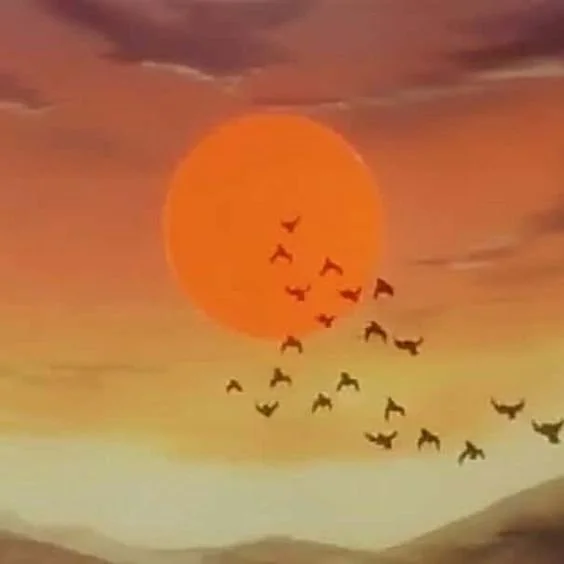
A flock of birds flying towards the orange sunset in Anime style.

After you finish your art piece…

In a notebook or on a piece of paper (it can be on the back of your art piece too), scribble and note down anything that is within your capacity to reflect on from this exercise.

Here are reflection questions for you:

• Were there any moments of slowing down, points in time yearning for attention from you?


• If resistance showed up: can you name what tried to protect you from going into this exercise or going into points of your grief that may be too big to handle in the moment. You are welcome to draw the resistance out too.

How did that go for you? If you wanted to share your artwork or thoughts, feel free to email me at linda@deciphercounselling.com.

Save this art therapy prompt and know you don’t have to complete this and take parts of the prompt if it lands well for you. If you know someone who may need this, sharing is caring :)

Thanks so much for being here.


An Art Therapy Prompt for When You Need Support


 The Floating Perspective, popularized by Guo Xi (郭熙), a Chinese painter from the Song dynasty, is the type of perspective commonly seen in historical Chinese art with sceneries where there is not a single view of a subject, but rather several shown at the same time, shifting from near to far vignettes.


I wanted to bring this creative way of relating our what we go through into art as therapy and I have an art prompt for you!


˚ ༘♡ ⋆。˚


Here's your art as therapy prompt: 
An Image of Concern
 

Draw out a concern* you want to view or acknowledge from (a) perspective(s) that is supportive, from (an) angle(s) that is safe-enough for your capacity at this moment.


*If you don’t like drawing or painting, you are so welcome to make digital art, create a collage, a sculpture or look for images on Pinterest that can represent what your concern is. Ideas here are limitless!


Exploring your image of concern from different angles can look like:

• peeking in: through a barrier (like glass window, or from a door)

• zooming out

• from a birds eyed view

• through a container with the problem inside

• inviting in someone you trust

• like that iceberg visual aid to see what’s on the surface and what may be underneath …and more…


You are welcome to alter and change this perspective whenever you revisit this image in the future.


Please be mindful of the sizing, material, border, making sure the materials you choose can hold your image of concern.


˚ ༘♡ ⋆。˚


And some reflection questions when you finish your art making process:


• What is it like to express this concern into an image?


• How do you relate to your concern; and is there a shift with how you relate to your image of concern?


• Is there a portion of this concern that is externalized (aka. you are no longer holding onto or blaming yourself for)?
 

• How do you receive context from your lived experience of your concern vs. your image of concern? 

Receiving context can be: information gathering, perspective taking, the organizing of the story of concern, getting feedback etc. (ask Chat GPT: "how do humans receive context from a problem in their life?" if you're stuck here)

How did that go for you? If you wanted to share your artwork or thoughts, feel free to email me at linda@deciphercounselling.com.

Save this art therapy prompt and come back to it for another day. If you know someone who may like this, share this prompt with them!

Thanks so much for being here and trying something new!


Why Art is an Act of Resistance

“Resistance and change often begin in art, and very often in our art; the art of words…the name of our beautiful reward is not profit, it is freedom.”

— Ursula Le Guin 


“This is not how a human face looks” “The proportion is not right”

At first, resistance towards making art sounds like the inner critic.

That “my drawing is not up to par so I am not an artist”. 


I’ve been noticing that these critiques are ideas that originated from colonialism of what art is and isn’t.

Colonization of art has changed the way we see art culturally, politically and socially. 


Under censorship and control (aka. capitalism), our creative practices has become commodified - where art should be made for profit and for some form of gain.


Art is an act of resistance

How can we start to make art for ourselves as resistance from colonialism and for joy?

How can we connect with our images and art making that isn’t based from a lens towards the fine arts?

…working with art and images as a means to resist socio-political oppression.


Anti-oppressive art therapists are working to reclaim our creative practice and decolonize art making with art therapy and contesting to structural oppression from the psychotherapy field.


Shaun McNiff wrote in his book, Trust the Process: An Artist's Guide to Letting Go, that “art therapists are like refugees from the art world”. I’d like to think of us as rebels of the art world instead.


So how have you been rebelling in your creative practice?


“All of that art-for-art’s-sake stuff is BS. What are these people talking about? Are you really telling me that Shakespeare and Aeschylus weren’t writing about kings? All good art is political! There is none that isn’t. 

I’m not interested in art that is not in the world. And it’s not just the narrative, it’s not just the story; it’s the language and the structure and what’s going on behind it.”

―Toni Morrison


Some forms of art as resistance I have been working with are: 


  • Making zines: a form of self-publishing art that came from feminist, activist movements popularized from the 80s. When I first started working as an art therapist, I created a workshop called, Zine Therapy (I was obsessed with making them). Zines are easy to distribute, low budget, and the content is filtered through the creator’s POV. My current faves are by Bianca ✨


  • Cartoons and memes: sometimes opinionated, other times sensitive, maybe brightly coloured or humorous, through a critical lens through doodles/animations or storytelling with images … like my friend's work by John! ✨


  • Clay/pottery: when I play with this earthy medium, themes around politics of the body and ‘smashing’ the patriarchy come up (💁‍♀️to get those air bubbles out). I love the meditative and trance-like feeling when I’m on the wheel… the way this medium holds memory and can be both delicate and forgiving—like healing with trauma.


If you wanted to share your thoughts, feel free to email me at linda@deciphercounselling.com.

Save this practice and come back to it for another day. If you know someone who may like this, share this blog post with them!

Thanks so much for being here :-)