Posts in Insight
Feeling processing vs rational processing; kin-based harm


from our November newsletter, written by Linda Lin, RCC, CCC, RCAT

In my previous blog post on generational diaspora, I mentioned I was visiting my mother’s homeland, China, for the first time in over a decade! It took me a few weeks to sit with this journey before writing about it.

This trip involved much more emotional processing than rational processing. Feeling our emotions in this way can be challenging, and from my experience in the therapy room, it often only comes after we’ve built enough trauma-informed language and awareness.


What’s the difference? Rational processing is structured and analytical, focused on collecting information and making critical deductions about what happened. Feeling processing, however, is experiential—it’s about listening to and working with what comes up, viscerally. It’s when we start noticing signs that have been there all along: sensations in our breath, a gnawing in our gut, the energy we pick up, and a pull toward creating new, supportive cycles for our body.


Feeling lost? I was—and probably still am. Words didn't come easily to describe this deeply sensory experience. Here are some emerging themes as I sat on the images I created from my trip:


Chapter 1: The play.


The impacts of historical imperial violence are complex, and when passed down through ancestral lineage, it lands differently from person-to-person in different points in their lives…yet they feel familiar. 


As a Chinese person born outside of China, I found it challenging to fully embody the audience's cultural resistance. This surprised me, considering I feel deeply in other spaces. It prompted me to reflect on what I may have internalized from the West—and how numb I must've felt during the play. This numbness might hint at open wounds, unprocessed grief, and the overwhelming sensation of feeling too much without a concrete anchor for my intersecting identities.


To all the children of immigrants navigating multiple cultures and facing relational tensions due to generational cultural gaps—how are you all holding up?

Everything is political - including my identity.


Identity conflicts have felt especially confusing throughout the trip. The harbouring of internalized sinophobia stemming from Western political narratives about China feels practically acceptable in today’s world (& with elections in the atmosphere). Unfortunately and to no surprise, I encountered a lack of engagement and curiosity about my trip from some friends. 


These encounters have prompted me to reflect deeply on my own journey with internalized sinophobia. Internalized racism functions as a product of unresolved trauma—a cycle of harm and violence rooted in politically engineered oppression.

The layers of kin-based harm and wounds of what could’ve been.


So I found out from my trip that my partner’s extended family members love each other, like sincerely. It's like the kind of love bell hooks talked about in her book, all about love. The kind of love with all 7 components: care, affection, recognition, respect, commitment, and trust, honesty and open communication. They've got a 75-person WeChat group, more than half of the group located in the city dine together every weekend and near 90-year-olds would keep the vibrant energy by playing mahjong into the early hours. They welcomed us with open arms, unconditional warmth and support. 


A few days later, I visited my mother’s side in a different province after 20 years and I was struck by anxiety and generational cycles playing out before me. I gave myself permission to bawl, allowing space to grapple with parts of myself that felt wronged by the stark contrasts in family dynamics and kinship.

It began to dawn on me that the heart of emotional processing wasn’t just about healing; it is about connection


Connection and care for the younger versions of myself, connection to parts of my culture and identity I want to keep discovering, and connection to kin who, in their imperfect ways, still attempt to show up for each other.

Be sure to sign up to our newsletter, Creative Ponders, where we share tidbits from our therapists, art prompts + new updates on offerings, delivered directly to your inbox!
 
 
This is what generational diaspora feels like


from our October newsletter, written by Linda Lin, RCC, CCC, RCAT

I’ll be out of the office this month as I embark on a trip to my mother's motherland, China. While I’d love to call it my own motherland, it doesn’t quite feel like that yet.


The definition of "motherland" is "the country of one's birth or origin, often with an emotional or cultural connection." For me, the emotional bond isn’t as deep as I wish it were, and I often wonder if my experiences could be called diasporic, since I wasn’t born there, nor do I speak in their exact tonality, regional dialect, or use their proverbs and slang. I have a feeling this trip will give me an opportunity to explore and hopefully build that connection to my generational diaspora.


If someone were to ask me, "What does generational diaspora feel like?"


What's coming up for me is:
• It feels more like a journey when I visit than a vacation or a break.
• Even though I can speak the language, it's still considered foreign.
• Even though I want to feel connected to the people and my extended family, it still feels foreign.
Missing kinship: Is there anyone here who truly gets me?
• To be honest, there’s general anxiety with every interaction: What if I feel let down by my race? What if I don’t fully understand their tonality and intentions? Do I really know the culture if I haven’t spent time here?
• Because separation from the land is such a complex struggle: Can it even be called diaspora when I was born elsewhere?


Interestingly, 'motherland' can also mean a place with significant ancestral importance, even if it’s not where you were born. In that sense, I hope to find a deeper connection to my roots during this journey.


Glowing stars floating across a nature landscape with grass and fir trees in the evening time

Realistically, two weeks may not be enough to fully connect with deep ancestral wisdom or break generational cycles. However, I hope this trip will serve as a catalyst, helping me reflect on decolonization and immerse myself in processing aspects of my generational diaspora.


A creative practice I will be tapping into during my trip as someone who is processing aspects of my generational diaspora


I recognize that, as a child of “immigrants,” my parents didn’t relocate by choice but out of necessity. Displacement and forced migration are central to how their story unfolded. I know this will show up in my body as I engage with the spaces I visit.


Whenever I have the capacity to recognize an embodied generational and historical wound coming up, I will be choosing to breathe into it as a practice. This means not trying to change it and practicing curiosity about this feeling.


When I visit places or have conversations with extended family and locals, I’ll pause and tune into how my body feels. These sensations—whether they evoke belonging, disconnection, yearning, or unease—will be important to notice.


I plan to translate these sensations into intuitive sketches, abstract drawings, or simple colour fields in my journal as a form of documentation (art as therapy if you will because I know that art is healing) in the next blog post. Weaving together the past and present will help me process my feelings around belonging and displacement.

Be sure to sign up to our newsletter, Creative Ponders, where we share tidbits from our therapists, art prompts + new updates on offerings, delivered directly to your inbox!


InsightLinda Lin
Healing with Cuteness: A New Activism Approach


from our newsletter, written by Linda Lin, RCC, CCC, RCAT

Maybe you can tell by now that 'dreamy nostalgia' is a core element of our therapy practice's identity. Lately, I've been exploring playfulness and cuteness not just as a look or an aesthetic, but as forms of resistance, rebellion, love, and radicalism.


Below are some reflections I put together!

The power of cute has not been explored enough.

In my search, I found it to be so odd that most articles that researched on cuteness were critiques of cuteness: infantilization, magical thinking, fetishization, being in denial as an adult, or packaged as simpler times.

Note: to be fair, I only searched the internet in the english language...

When I think about cuteness, it aligns with the most resilient parts of my current adult self and the purest parts of the younger versions of myself.

Cuteness is a point where I get to come closer to my personal interests without shame and embarrassment, liberating parts of me without oppressive restrictions like age-limit, how to dress or act or what’s appropriate or legit/professional.

Here are 4 thoughts on cuteness as resistance that can light us up:

  1. cuteness as camoflauge:

when talking about serious topics like historical trauma, racism, or transphobia...

cuteness aids in politicizing conversations and reflections in a digestable, resonating and nostalgic way.

Cuteness helps us critique, question, reflect how we've been socialized, while mixing in elements of play.

2. cuteness is kitsch:

Kitsch is a German word for ‘worthless trashy art’, critiquing the quality of the art

Cuteness is our mark on decolonizing what art can be instead of art ‘should be’. It challenges the traditional ‘fine’ arts, dismantle and unarm systemic rules.

Cuteness helps folks tap in the power of making ‘bad art’.

Who knew that a sense of playfulness and absurdity can help realign my creative practice for pleasure and expression as a fundamental human right.

3. in postmodernism:

Cuteness helps me dream of a reality that makes sense.

Because a world that’s a dumpster fire isn’t cute and not going to cut it.

It helps me sustain optimism and conduct small acts of resistance through orienting to the playful parts of life and imagination.

4. Cuteness as relief

Cuteness charges our energy in the realm of healing.

Cuteness inspires us to connect with the softness, gentleness, kindness, loveliness which embodies safe moments so we don’t disconnect from the heaviness of everyday struggles.

It's probably why corporate workers love cute animal videos and memes to get through the day.

Resources that inspired my research:

Cute affectivism: radical uses of the cuteness affect among activists and artists by Ingeborg Hasselgren

• @umeboi's tiktoks and reflections on kitsch in contemporary art and cuteness


The 3 Levels of Consciousness


from our newsletter, written by Linda Lin, RCC, CCC, RCAT

Instead of accepting the status quo, the intergenerational trauma and oppression that society normalizes, you are more interested in what we need to change, and ways to break the cycle.


You have probably been developing and fine-tuning your critical awareness.

When we find ourselves questioning everything around us and don’t take anything at face value, we begin to see where change is needed.


“Knowing who I am informs what I want to change.”


When we embrace our identities and declare our positionality, it adds depth, richness and meaning to everything we do.
 

Knowing yourself is arguably the first step it took for me to build critical awareness.

So what is critical awareness/consciousness?

As we are navigating in this dystopian world, our levels of consciousness can shift in and out as responses to overwhelm. Paul Freire's (1973) work outlined 3 levels of consciousness


Level 1 Magical consciousness: a stage where we are silent, docile and in denial. We accept injustices because it is the way of the world and we believe that it is our destiny or fate. 
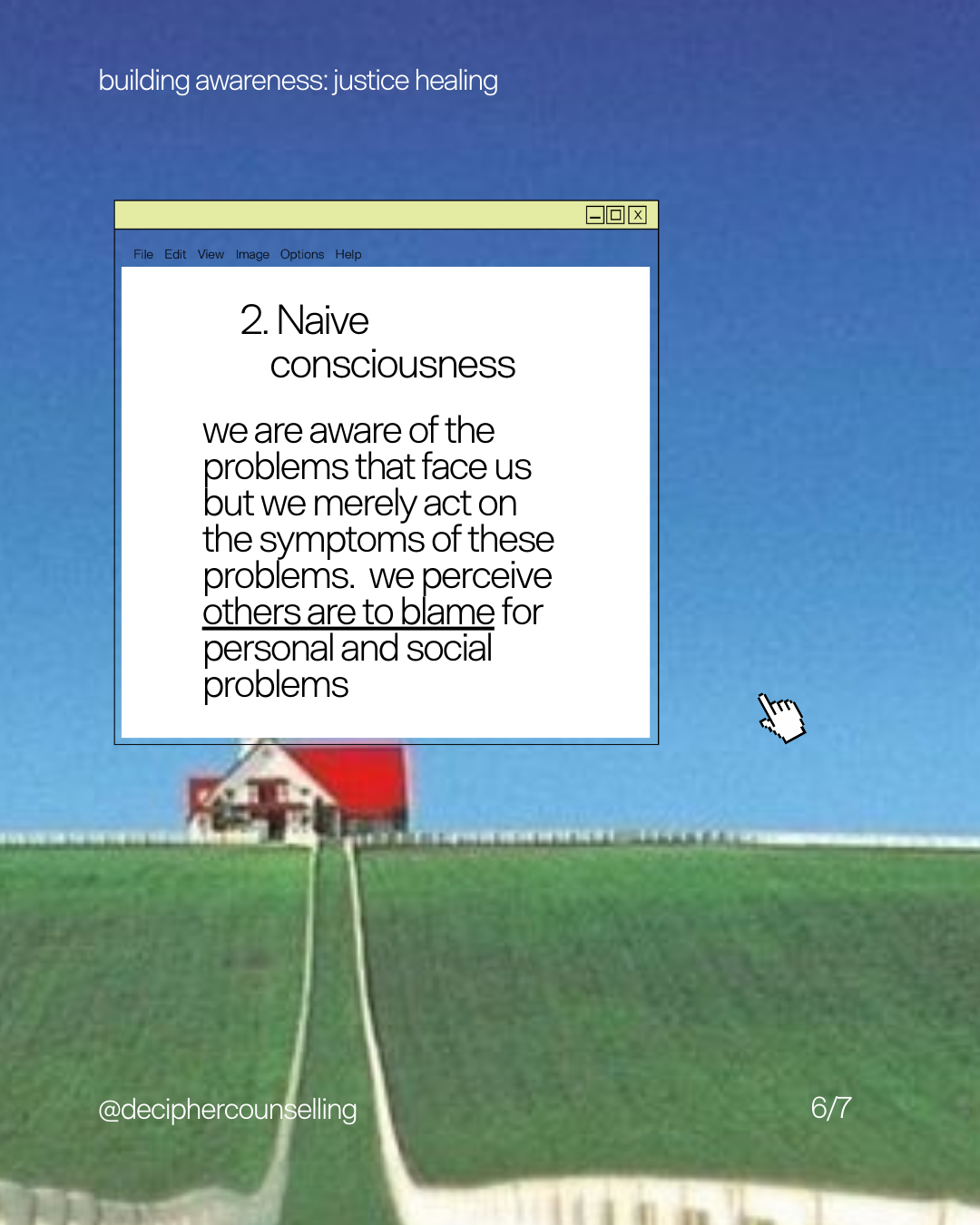
Level 2 Naïve consciousness: we are aware of the problems that face us but we merely act on the symptoms of these problems. We perceive others are to blame for personal and social problems.
Level 3 Critical consciousness: we question the world around us and examine the root and structural causes of the issues that face us rather than accepting this is simply what has been dealt to us and beyond our power to change.

Here's a hot take…

I am convinced that we have all been in magical consciousness at some point or another!


Whether it's about climate change, racism, ableism, stigma or divisiveness around gender orientations, social classes, types of education… we live under multiply oppressive systems and I am pretty sure we experience these 3 levels of consciousness all the time.


You probably have a loved one, or friend group or acquaintances who do not perceive our actions as capable of changing conditions… and, I want to remind you that hope isn’t an emotion or optimism, hope is a discipline (as quoted by Mariame Kaba).

If you are dreaming of better and brighter futures for yourself and us all on a certain area, what informs you of this hope for liberation?

Why would this be showing up for you so strongly?

・₊✧

Perhaps there is a soul wound…

Soul wound: 

the psycho-spiritual damage peoples suffer from historical trauma, intergenerational trauma and colonization. Another interpretation I found of the 'soul wound' is the moral injury that pierces a person's identity, sense of morality, and relationship to society.

Here are some ways to sustain our soul:
 

Soul care is caring for each other. When the soul or culture of certain groups are oppressed, we need to find each other who are radicalizing from the wounding so we can liberate from such oppression in small communities at a time.


Tending to our bodyminds. For example, healthy ways to release rage if you have been feeling this could be to seek community, bring in movement and singing (activates our vagus nerve), or join creative workshops. Choosing to support our bodyminds are small and mighty ways to live authentically, so we have room to take care of each other.


Community and belonging. We navigate repression effectively in community. Hope in our ability to get through hardships together makes us resilient and powerful. As Decipher is approaching year 4 as a therapy practice, I have been brainstorming ways to foster more third space elements: spaces outside of work and home that bring a sense of belonging, collaboration and community.


Committing to lifelong learning. It is incredibly humbling when critical consciousness builds within us: when it continues to witness, call out, and awaken parts of us that have been laying dormant due to internalized -isms from living in an oppressive world.


If you are needing to play, rest and fuel your creative spirit to continue showing up for collective liberation, I am collaborating with my friend, Monica from Level V Bakery to bring you 4 workshops this Summer! Save your spot in the link below and share with your friends 🫶