What are the markers of your healing?


from our newsletter, written by Linda Lin, RCC, CCC, RCAT

There can be a lot of complexity in our healing process. I’ve been reflecting on the question, how do I recognize I’m healing? What are markers that I am healing? Read below for some reflections from a human who thinks about healing for a living ↓

Transcript from the images above (and a few additional points because I like giving a little extra):

There can be a lot of complexity in our healing process. I’ve been reflecting on the question, how do I recognize I’m healing? What are markers that I am healing?

Here’s a case study:

I'm highly skilled at managing crises (even when no one asks), and when I feel overwhelmed, my version of spiraling or losing control manifests as hyper-independence and trying to help others regulate—sometimes to no avail.

Markers of Healing:

  • Asking for help

  • Being less tolerant of situations or people that overwhelm me

  • Building awareness of where my disappointment and rage come from

When I'm conscious of my capacity and focus on regulating myself rather than others, I can communicate more clearly about what's bothering me and how others can support me.

Healing looks really different from person to person. Markers can feel like I’m able to release something that I was bound to or restricted by. It feels expansive, courageous, a wrecking ball and other times, subtle, uncomfortable, unfamiliar, and awkward in our bodies. 

Here are a few maybe more obvious, yet challenging, signs of healing:

  • Differentiating between your present adult self and the past self who experienced those events, recognizing that what happened is no longer happening to you.

  • Recognizing trauma responses for what they are instead of internalizing them as shame or disconnecting from your body and your experiences.

  • Having a clearer point of reference for safety, security, and trust in relationships. You start to understand what these things look and feel like.

  • Accepting that you don’t always have to be right, perfect, or efficient. “Good enough” becomes an option, and rather than striving to be the best, you choose to relax more often.

  • When you no longer feel the urge to mentally craft a resignation letter every time you walk into work, and you’re actively using your extended health benefits to support your wellness.

And a few maybe less obvious signs of healing:

  • Noticing the contradictions of thoughts that sound like internalized messages of professionalism, perfectionism, or ableism. They are probably there to try to make sure you feel accepted by others. They are protector parts and are not needed as much when you are healing creatively.

  • Similar to the one above, you are making space to nurture the protective parts that have developed when you were wounding. For example instead of trying to let go/get rid of comparing your body with others, you notice that your worries of whether you can fit in and are accepted comes from internalized messages from generations of diet culture, sizeism, and patriarchy you are still struggling with. If these systems are STILL THERE, these thoughts will STILL EXIST.

  • Learning from the points above, you are noticing that if you are wanting single solutions for single issues, it doesn’t work. 

  • In relationships, instead of usual avoidant responses in your relationships, you might start experimenting with other types of responses, then see yourself shifting how you respond altogether. These changes don’t always look like healing, but your voice becomes clearer, and you have a growing awareness of different perspectives and more space to reflect.

  • You are no longer needing to heal your grief and wounds. That movement and growth in healing doesn’t always look like ‘recovery’ or getting to a new destination at all. Sometimes it looks more like awareness, understanding/forgivingness/holding space, grieving, weaving in and out and playing with familiar patterns with non-familiar ones. 

  • You are recognizing when we are dysregulated, it isn’t about the present moment, and the goal isn't just to calm your nervous system. It’s about finding relief and reclaiming your sense of agency and power. It's about rediscovering who you truly are: deserving, capable, and powerful.

  • You are choosing to experience and embody joy, creativity, connection as a way to liberate ourselves from the dumpster fire of this world.

TLDR;

How can we recognize markers of healing? (some main elements)

…when you’re able to claim your sense of agency and power

…when you can see more perspectives, a slow expansion from tunnel vision

…when you can differentiate what is present from an emotional flashback from the past

…healing can look like shifting from self-protection to self-awareness and a non-linear view on healing altogether

Be sure to sign up to our newsletter, Creative Ponders, where we share tidbits from our therapists, art prompts + new updates on offerings, delivered directly to your inbox!


Linda Lin
Healing with Cuteness: A New Activism Approach


from our newsletter, written by Linda Lin, RCC, CCC, RCAT

Maybe you can tell by now that 'dreamy nostalgia' is a core element of our therapy practice's identity. Lately, I've been exploring playfulness and cuteness not just as a look or an aesthetic, but as forms of resistance, rebellion, love, and radicalism.


Below are some reflections I put together!

The power of cute has not been explored enough.

In my search, I found it to be so odd that most articles that researched on cuteness were critiques of cuteness: infantilization, magical thinking, fetishization, being in denial as an adult, or packaged as simpler times.

Note: to be fair, I only searched the internet in the english language...

When I think about cuteness, it aligns with the most resilient parts of my current adult self and the purest parts of the younger versions of myself.

Cuteness is a point where I get to come closer to my personal interests without shame and embarrassment, liberating parts of me without oppressive restrictions like age-limit, how to dress or act or what’s appropriate or legit/professional.

Here are 4 thoughts on cuteness as resistance that can light us up:

  1. cuteness as camoflauge:

when talking about serious topics like historical trauma, racism, or transphobia...

cuteness aids in politicizing conversations and reflections in a digestable, resonating and nostalgic way.

Cuteness helps us critique, question, reflect how we've been socialized, while mixing in elements of play.

2. cuteness is kitsch:

Kitsch is a German word for ‘worthless trashy art’, critiquing the quality of the art

Cuteness is our mark on decolonizing what art can be instead of art ‘should be’. It challenges the traditional ‘fine’ arts, dismantle and unarm systemic rules.

Cuteness helps folks tap in the power of making ‘bad art’.

Who knew that a sense of playfulness and absurdity can help realign my creative practice for pleasure and expression as a fundamental human right.

3. in postmodernism:

Cuteness helps me dream of a reality that makes sense.

Because a world that’s a dumpster fire isn’t cute and not going to cut it.

It helps me sustain optimism and conduct small acts of resistance through orienting to the playful parts of life and imagination.

4. Cuteness as relief

Cuteness charges our energy in the realm of healing.

Cuteness inspires us to connect with the softness, gentleness, kindness, loveliness which embodies safe moments so we don’t disconnect from the heaviness of everyday struggles.

It's probably why corporate workers love cute animal videos and memes to get through the day.

Resources that inspired my research:

Cute affectivism: radical uses of the cuteness affect among activists and artists by Ingeborg Hasselgren

• @umeboi's tiktoks and reflections on kitsch in contemporary art and cuteness


The 3 Levels of Consciousness


from our newsletter, written by Linda Lin, RCC, CCC, RCAT

Instead of accepting the status quo, the intergenerational trauma and oppression that society normalizes, you are more interested in what we need to change, and ways to break the cycle.


You have probably been developing and fine-tuning your critical awareness.

When we find ourselves questioning everything around us and don’t take anything at face value, we begin to see where change is needed.


“Knowing who I am informs what I want to change.”


When we embrace our identities and declare our positionality, it adds depth, richness and meaning to everything we do.
 

Knowing yourself is arguably the first step it took for me to build critical awareness.

So what is critical awareness/consciousness?

As we are navigating in this dystopian world, our levels of consciousness can shift in and out as responses to overwhelm. Paul Freire's (1973) work outlined 3 levels of consciousness


Level 1 Magical consciousness: a stage where we are silent, docile and in denial. We accept injustices because it is the way of the world and we believe that it is our destiny or fate. 
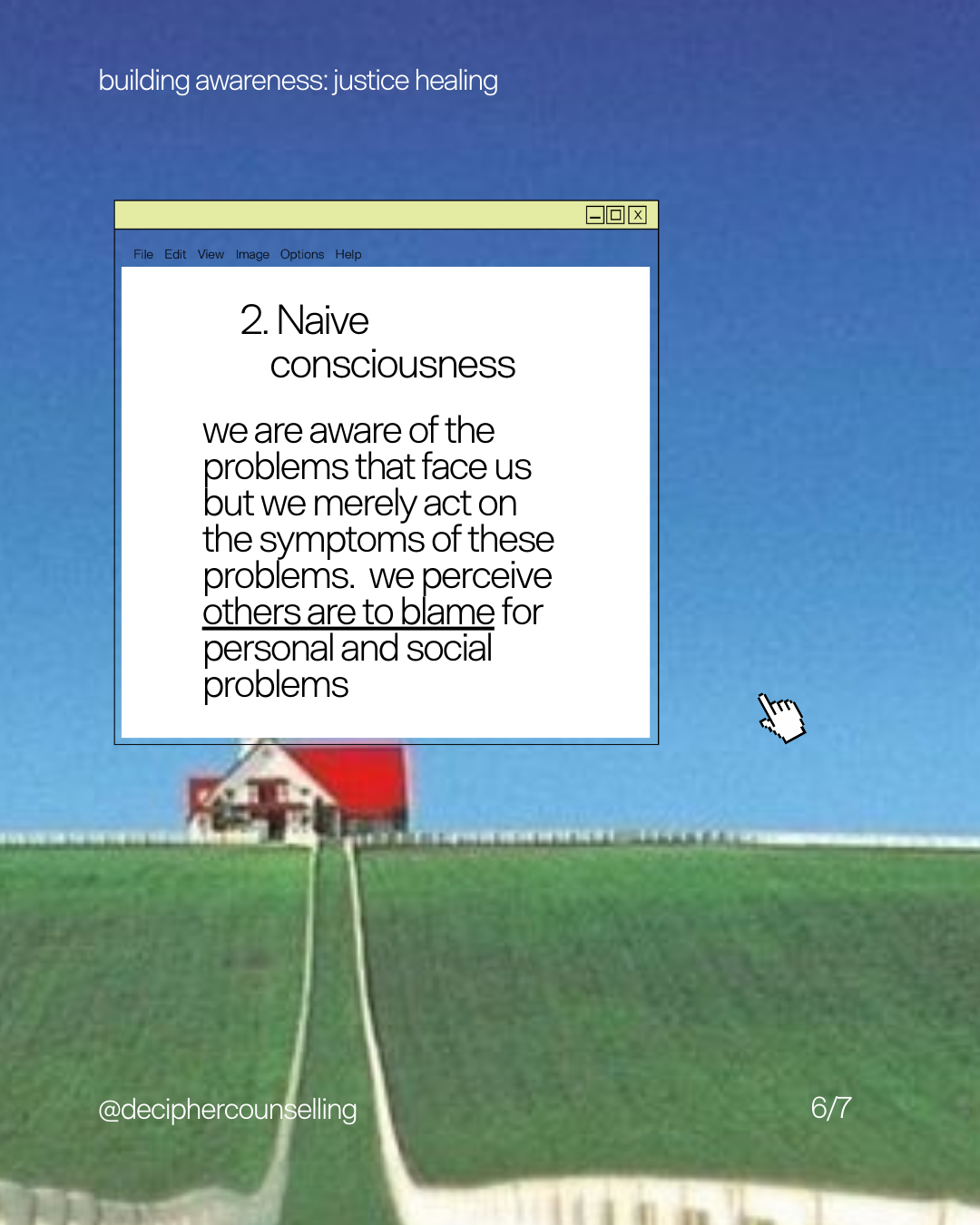
Level 2 Naïve consciousness: we are aware of the problems that face us but we merely act on the symptoms of these problems. We perceive others are to blame for personal and social problems.
Level 3 Critical consciousness: we question the world around us and examine the root and structural causes of the issues that face us rather than accepting this is simply what has been dealt to us and beyond our power to change.

Here's a hot take…

I am convinced that we have all been in magical consciousness at some point or another!


Whether it's about climate change, racism, ableism, stigma or divisiveness around gender orientations, social classes, types of education… we live under multiply oppressive systems and I am pretty sure we experience these 3 levels of consciousness all the time.


You probably have a loved one, or friend group or acquaintances who do not perceive our actions as capable of changing conditions… and, I want to remind you that hope isn’t an emotion or optimism, hope is a discipline (as quoted by Mariame Kaba).

If you are dreaming of better and brighter futures for yourself and us all on a certain area, what informs you of this hope for liberation?

Why would this be showing up for you so strongly?

・₊✧

Perhaps there is a soul wound…

Soul wound: 

the psycho-spiritual damage peoples suffer from historical trauma, intergenerational trauma and colonization. Another interpretation I found of the 'soul wound' is the moral injury that pierces a person's identity, sense of morality, and relationship to society.

Here are some ways to sustain our soul:
 

Soul care is caring for each other. When the soul or culture of certain groups are oppressed, we need to find each other who are radicalizing from the wounding so we can liberate from such oppression in small communities at a time.


Tending to our bodyminds. For example, healthy ways to release rage if you have been feeling this could be to seek community, bring in movement and singing (activates our vagus nerve), or join creative workshops. Choosing to support our bodyminds are small and mighty ways to live authentically, so we have room to take care of each other.


Community and belonging. We navigate repression effectively in community. Hope in our ability to get through hardships together makes us resilient and powerful. As Decipher is approaching year 4 as a therapy practice, I have been brainstorming ways to foster more third space elements: spaces outside of work and home that bring a sense of belonging, collaboration and community.


Committing to lifelong learning. It is incredibly humbling when critical consciousness builds within us: when it continues to witness, call out, and awaken parts of us that have been laying dormant due to internalized -isms from living in an oppressive world.


If you are needing to play, rest and fuel your creative spirit to continue showing up for collective liberation, I am collaborating with my friend, Monica from Level V Bakery to bring you 4 workshops this Summer! Save your spot in the link below and share with your friends 🫶


Cyclebreakers: are you working to live or living to work?


from our newsletter, written by Linda Lin, RCC, CCC, RCAT

Have you ever heard of the saying, 'work to live’, instead of ‘live to work’ and wondered… how the heck do I do that?


…Perhaps there's something gnawing inside of you when you hear that you have a choice to “live” fully/presently.

…Perhaps you are seeking for self-actualization or a spiritual awakening of some sort, to transform and do some healing.

…Perhaps you are similar to myself, in which they call a ‘cyclebreaker’.

…Then maybe you're in the right place 💗


In these past few years, I found myself exploring rest as resistance and strategizing ways to escape capitalism (which is a system that uses humans as commodities) with the intention of living wholly as a liberation practice.


I sense in my body, that when I verbalize these words above, it's still fresh. Kind of like discovering a treasure chest that’s been locked up under the sea for a very long time.


Sometimes I wonder if an ancestor from my lineage has called out unjust systems before and the wisdom got lost along the way.

Or if they were punished for questioning it.

Or that no one has ever cared to be critical of it until little old me.


In this journey, I am discovering just how deep intergenerational wounds can be, especially when it comes to my relationship with work for survival…

 ₊˚ ☁️・₊✧ 

Healing justice is when we reflect, observe and recognize how systems we seek to change outside of our bodies are also carried within our bodies.

To feel worthy of rest is not easy for me and my lineage!

In fact, it's an arduous feat for someone like me to find exits out of stifling spaces and experiences. I find myself crisis managing, keeping up with thoughts of what is expected of me in moments when I need to listen to myself and need rest the most.


(Below is me rambling so you can choose to skip past this)

I heard stories that each of my parents took on multiple jobs to save up for a one-way ticket to come from their motherland to a new continent, leaving the rest of their families physically behind and sending back the fruits of their labor to support them financially. Growing up, it was normalized to not take weekends off. With barely any time for relational building and quality time, this never-ending hamster wheel has played like a broken record.


(Okay, I would LOVE for you to read this )

Breaking the cycle means unwinding intergenerational wounds of up to 14 generations!

Please note that it is NOT about breaking the entire 14 generations of burdens, and that if you still struggle with the cycle showing up, you are no longer a cycle breaker. The focus is more about building awareness of personal responses, of family's history and ancestors' stories, as well as cultural woundings. Being a cycle breaker is about building critical consciousness (will write more about this in the next newsletter) of what is the wound that your lineage and yourself have been carrying. 


In the therapy room, I have been practicing remembering that when clients/folks are in session with me, I may be witnessing up to 500 years of ancestral wisdom, cultural and historical stuff showing up.


Hey, I recognize that this practice sounds intimidating. However, it serves as a reminder that we are incredible humans who can carry some pretty heavy stuff.

We are on this journey of liberating ourselves, future generations and organizing with community for a better world. That’s some superhero typa power 💪

・₊✧  Take a deep breath here   ☁️・₊


Some gentle reminders I tell myself:


"I will notice more presence, tend to my body and mind, and feel my heart space soften.

There will be many more moments where I catch myself in labor when I could have chosen to relax. That is because these systems are designed for me to sense risk if I were to choose to rest (ahem… due to capitalism, patriarchy, intergenerational wounds… ahem).

There will be many more moments where choices to rest will become closer within reach. When I am no longer defined by the disconnection, violence, betrayal and disregard of my healing."


꩜   𖦹   ꩜   𖦹   ꩜


Here's a journalling/art prompt for you, or a conversation you may choose to have with your community:


What is it that you are hoping to break in this lifetime?


-Linda